1. AU-guided semantic prompting
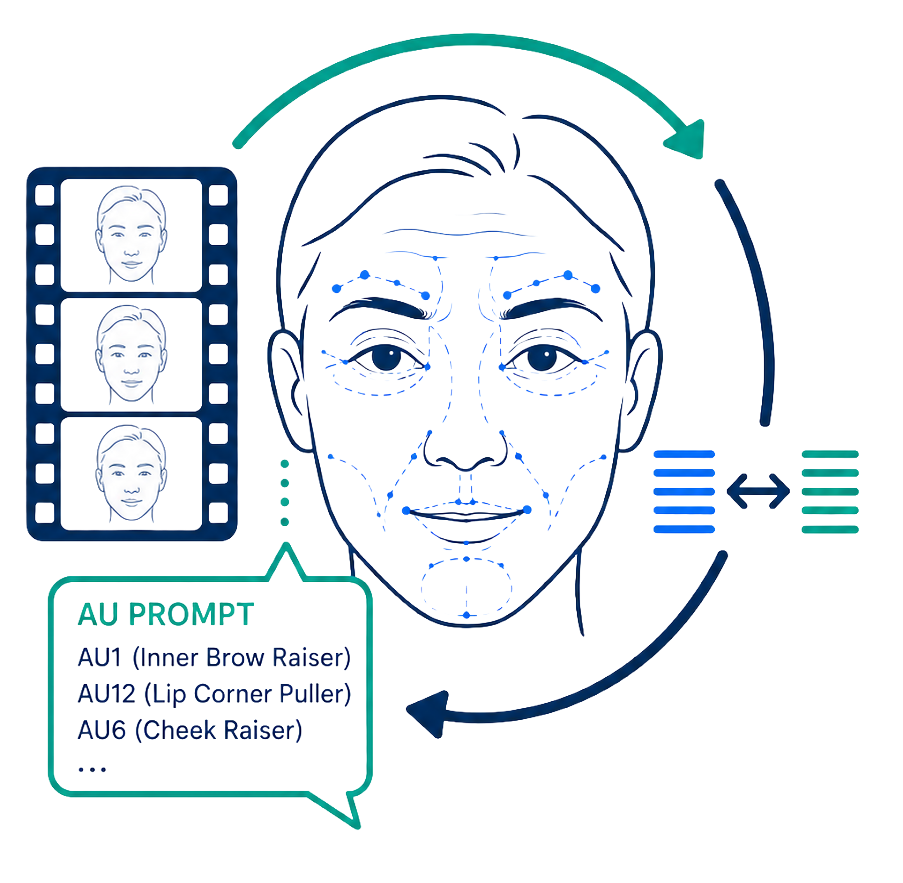
Facial Action Units provide structured and interpretable prompts that ground emotion recognition in localized facial movements rather than generic class descriptions.
Test-Time Personalization with Action Unit Prompting for Fine-Grained Video Emotion Recognition
The 19th European Conference on Computer Vision, Malmö, Sweden
Personalization in emotion recognition (ER) is essential for an accurate interpretation of subtle and subject-specific expressive patterns. Recent advances in vision–language models (VLMs) such as CLIP demonstrate strong potential for leveraging joint image–text representations in ER. However, CLIP-based methods either depend on CLIP’s contrastive pretraining or on LLMs to generate descriptive text prompts, which are noisy, computationally expensive, and fail to capture fine-grained expressions, leading to degraded performance. In this work, we leverage Action Units (AUs) as structured textual prompts within CLIP to model fine-grained facial expressions. AUs encode the subtle muscle activations underlying expressions, providing localized and interpretable semantic cues for more robust ER.
We introduce CLIP-AU, a lightweight AU–guided temporal learning method that integrates interpretable AU semantics into CLIP. It learns generic, subject-agnostic representations by aligning AU prompts with facial dynamics, enabling fine-grained ER without CLIP fine-tuning or LLM-generated text supervision. Although CLIP-AU models fine-grained AU semantics, it does not adapt to subject-specific variability in subtle expressions. To address this limitation, we propose CLIP-AUTT, a video-based test-time personalization method that dynamically adapts AU prompts to videos from unseen subjects. By combining entropy-guided temporal window selection with prompt tuning, CLIP-AUTT enables subject-specific adaptation while preserving temporal consistency. Our extensive experiments on three challenging video-based subtle ER datasets — BioVid, StressID, and BAH — indicate that CLIP-AU and CLIP-AUTT outperform state-of-the-art CLIP-based FER and TTA methods, achieving robust and personalized subtle ER.
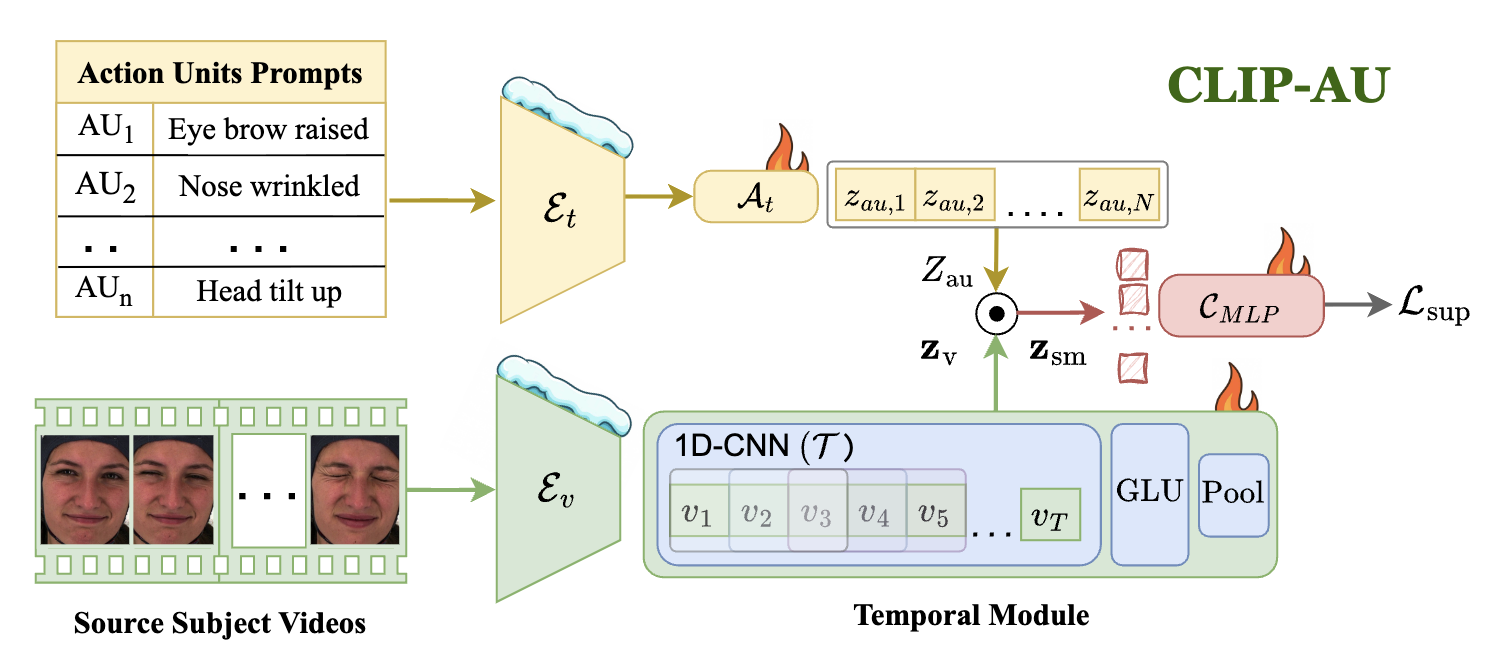
CLIP-AU learns AU-guided temporal emotion cues with structured Action Unit prompts.
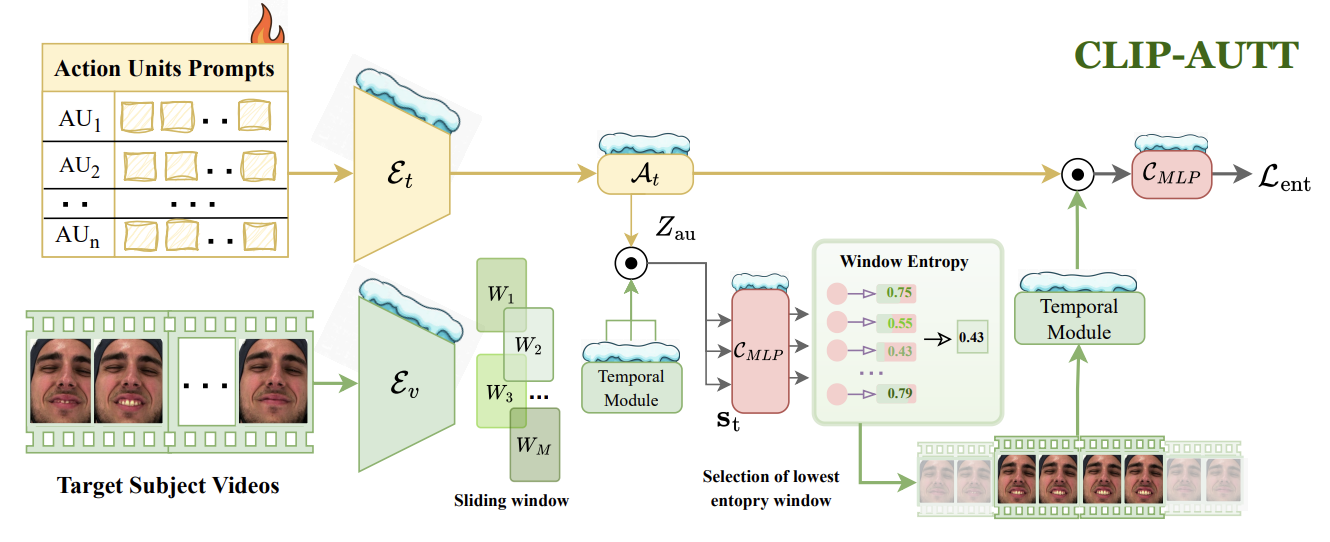
CLIP-AUTT adds entropy-guided temporal window selection and test-time AU prompt personalization.
Facial Action Units provide structured and interpretable prompts that ground emotion recognition in localized facial movements rather than generic class descriptions.
The model learns one-to-many relationships between emotion classes and their associated AU patterns, allowing it to detect corresponding facial cues across video frames and learn a generic classifier for subtle emotion recognition.
A small set of AU prompt embeddings is adapted to each unseen, unlabeled target subject. Entropy-guided window selection identifies the most informative video segment, enabling subject-specific personalization without full-model retraining or access to source data.
Following Fig. 1(d) of the paper, this analysis compares throughput, WAR, trainable parameters, and GFLOPs for FT CLIP, EmoCLIP, X-CLIP, Exp-CLIP, CLIP-AU, and the CLIP-AUTT point shown in the original figure. CLIP-AU reaches a strong fine-tuning tradeoff with 78.0% WAR, 16.9 videos/sec throughput, only 1.3M trainable parameters, and 0.124 GFLOPs, while CLIP-AUTT appears in the high-throughput, high-accuracy region.
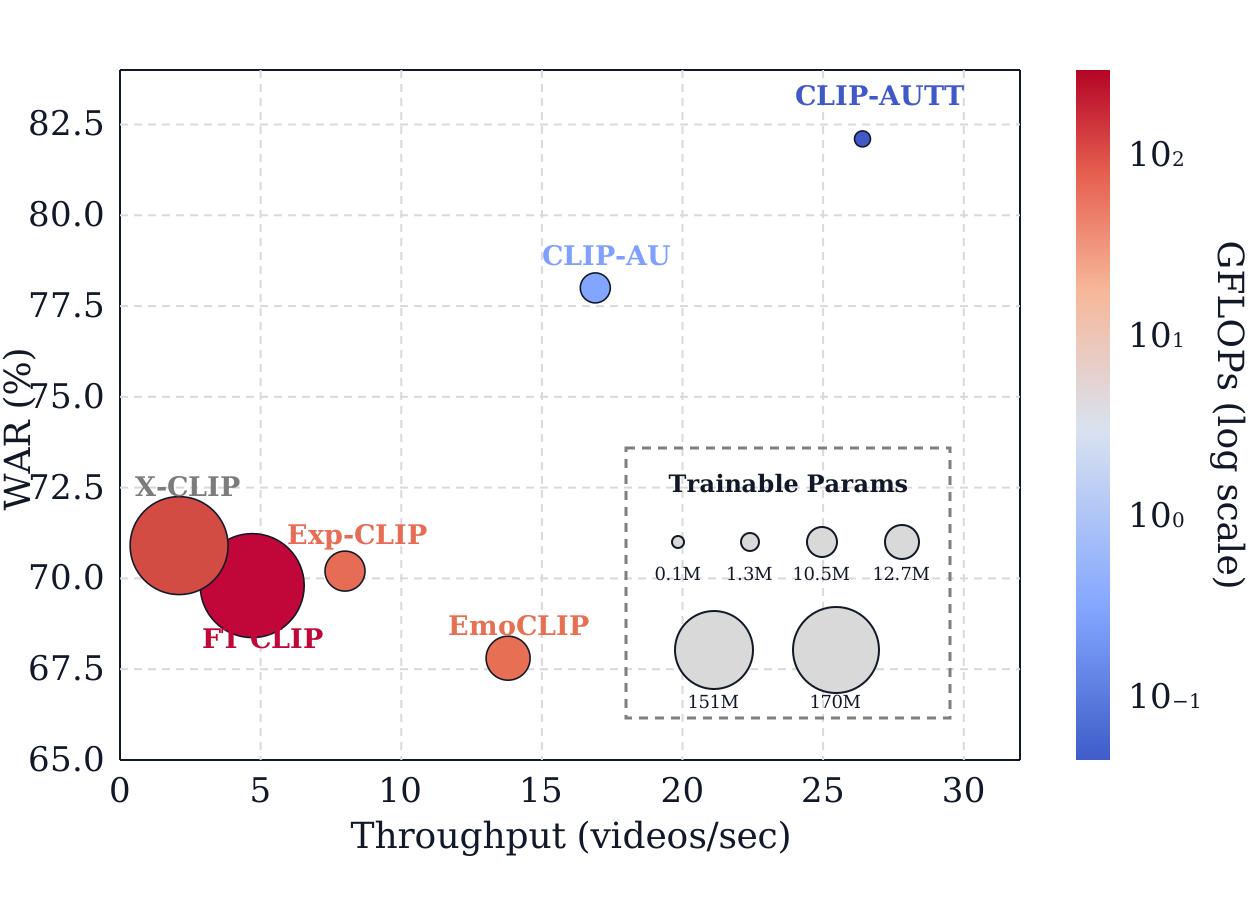
Efficiency and complexity summary from Fig. 1(d): marker size encodes trainable parameters, color encodes GFLOPs on a log scale, and CLIP-AU provides the strongest balance of accuracy, speed, parameter efficiency, and compute.
Table 1 reports averaged results over 10 target subjects per dataset. CLIP-AU improves the fine-tuning setting with AU-guided temporal alignment, while CLIP-AUTT provides the strongest test-time adaptation results across BioVid, StressID, and BAH.
| Setting | Method | BioVid | StressID | BAH | |||
|---|---|---|---|---|---|---|---|
| WAR | F1 | WAR | F1 | WAR | F1 | ||
| ZS | CLIP-ViT-B/32 (ICML’21) | 50.0 | 33.3 | 60.4 | 34.8 | 39.5 | 28.1 |
| FT | CLIP-ViT-B/32 (ICML’21) | 69.7 | 66.6 | 67.0 | 44.5 | 60.4 | 39.8 |
| EmoCLIP (FG’24) | 67.7 | 63.4 | 63.5 | 35.9 | 56.2 | 36.5 | |
| X-CLIP (ECCV’22) | 70.9 | 57.9 | 62.3 | 41.3 | 63.0 | 39.2 | |
| Exp-CLIP (WACV’25) | 70.2 | 66.7 | 63.1 | 44.5 | 62.2 | 38.5 | |
| CLIP-AU | 78.0 | 74.8 | 66.5 | 58.5 | 68.3 | 40.3 | |
| TTA | TPT (NeurIPS’22) | 71.1 | 67.5 | 70.9 | 57.9 | 65.6 | 39.7 |
| TDA (CVPR’24) | 71.4 | 68.2 | 69.7 | 49.9 | 65.2 | 39.9 | |
| DPE (NeurIPS’24) | 73.1 | 69.6 | 71.3 | 54.2 | 66.7 | 39.4 | |
| PromptAlign (NeurIPS’23) | 75.3 | 71.6 | 74.6 | 53.2 | 67.1 | 39.7 | |
| ReTA (ACMMM’25) | 75.1 | 71.3 | 71.8 | 52.8 | 67.6 | 39.8 | |
| T3AL (CVPR’24) | 76.1 | 72.9 | 75.9 | 59.4 | 67.9 | 40.7 | |
| CLIP-AUTT | 81.5 | 78.0 | 80.8 | 77.9 | 69.8 | 41.1 | |
The right side of Fig. 4 qualitatively compares top activated AUs from CLIP-AU and CLIP-AUTT against AU activations estimated by OpenFace. The adapted CLIP-AUTT prompts better align with subject-specific eye and mouth movements, producing more meaningful AU combinations for the target subject.
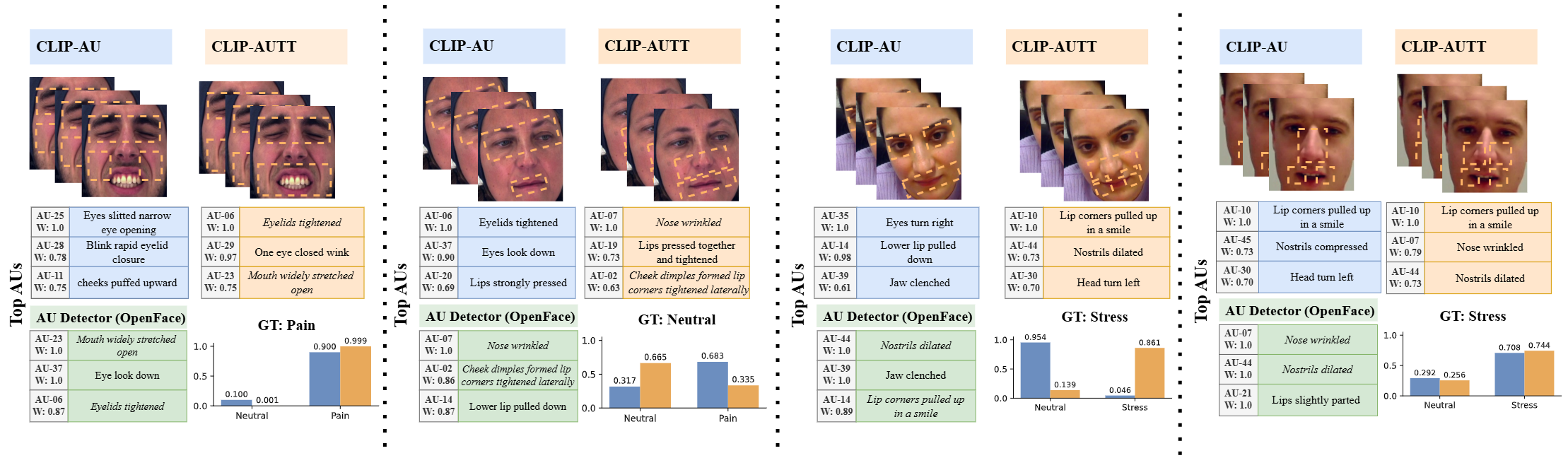
Visualization inspired by Fig. 4 right: CLIP-AUTT refines generic AU semantics into more subject-specific AU activation patterns.
Action Unit prompts connect model predictions to recognizable facial muscle movements.
Prompt tuning at inference time personalizes the representation for unseen individuals.
The method targets real-world behavioral analysis where labels are scarce and expressions are subtle.
@inproceedings{zeeshan2026clipautt,
  title={CLIP-AUTT: Test-Time Personalization with Action Unit Prompting for Fine-Grained Video Emotion Recognition},
  author={Zeeshan, Muhammad Osama and Sharafi, Masoumeh and Savary, Beno{\^i}t and Koerich, Alessandro Lameiras and Pedersoli, Marco and Granger, Eric},
  booktitle={In ECCV 2026: The 19th European Conference on Computer Vision, Malmö, Sweden},
  year={2026}
}This research was partially supported by the Natural Sciences and Engineering Research Council of Canada, Fonds de recherche du Québec – Santé, Canada Foundation for Innovation, and the Digital Research Alliance of Canada.
For questions, discussion, or collaboration, please reach out to the authors.